
When One Footballer Stopped a Civil War….
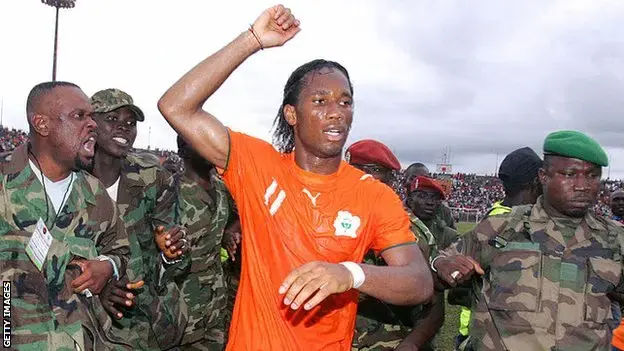
By 2005, Côte D’Ivoire was deep in civil war. The country was in its third year of domestic conflict between President Laurent Gbagbo and the rebel faction ‘New Forces of the Ivory Coast.’ By the end of the conflict in 2007, the highest estimates stated 4,000 had been killed, and over 750,000 had been displaced. Yet one of the most crucial factors in ending this conflict was Chelsea striker Didier Drogba……...
Drogba signed for Chelsea in 2004 for £24 million, a record at the time for a Premier League striker and was part of a golden generation of Ivorian talent hoping to qualify for the 2006 World Cup. On 8 October 2005, the Ivorians took to the pitch to play their last World Cup qualifier against Sudan. Côte D’Ivoire needed a win in this game, and for Cameroon to draw or lose in their game against Egypt the same day, to qualify for their first-ever World Cup. The pressure was massive, but that didn’t stop the Ivorians from winning 3-1, and after Cameroon missed their last-minute penalty, the Ivorians qualified.
During the celebrations, a TV camera was brought into the dressing room, and Drogba spoke directly to his country in an address that lasted just one minute: “Today we beg you on our knees, please lay down your weapons and hold elections.” While the country celebrated the result and woke up in the morning still at war, this address sparked a change in the atmosphere. Drogba’s words were played relentlessly on TV, and a strong spirit for change took over, which eventually resulted in both sides coming back to the negotiating table and the signing of ceasefire terms in June 2005. It was nothing short of extraordinary that this could actually be linked back to 11 men on a football pitch.
This was not the end of the Hollywood-esque story, however, as after a respectable showing at the 2006 World Cup, Drogba announced that the deciding qualifying game for the 2008 AFCON against Madagascar would be held in Bouake, the symbolic home of the rebellion. The game was a spectacle for unity and national pride, with government and rebel troops both attending and chanting together, in the absence of fighting one another. Across the country in places like Abidjan, people even finished work early to drink and watch the game together. The Ivorians won the game 5-0 with Drogba scoring the final goal and securing qualification. It was a beautiful moment that showed how football can bring a nation together, marking the closing of the war and hope towards a brighter, more peaceful future.
Unfortunately, the future was not as peaceful as hoped. The joy created from those two symbolic games was forgotten, and by 2010, a Second Civil War broke out after Gbagbo tried to hold onto power following a loss at the 2010 general election. The Second Ivorian Civil War saw 3,000 killed and a million people fled the country, mainly from Abidjan. Similarly, the golden generation of Ivorian football lost on penalties in the 2006 and 2012 AFCONs.
Didier Drogba may have retired having never become an African champion, but his effort to stop the first civil war definitely showed he was a champion of Africans, so much so that he was even declared UNDP Goodwill Ambassador in 2007.


Comments